
The Rule 30 Fault Line



Requires a Wolfram Notebook System
Interact on desktop, mobile and cloud with the free Wolfram Player or other Wolfram Language products.
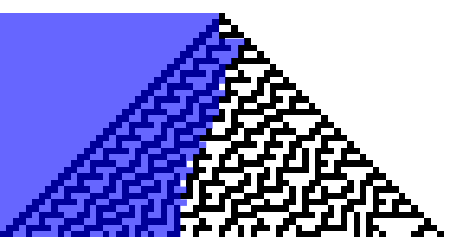
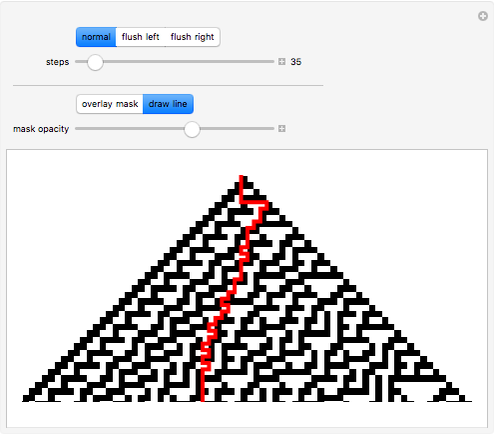
Rule 30 of the elementary cellular automata (CA) was among the first rules in which Stephen Wolfram noticed the appearance of intrinsic randomness in a deterministic system. When initialized with a single black pixel there is patterned behavior down both sides of the unfolding CA which gives way to the randomly patterned center. In fact, Mathematica uses the center column of pixel values as one of its random number generators.
Contributed by: John Kiehl (March 2011)
Open content licensed under CC BY-NC-SA
Snapshots
Details
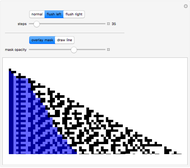
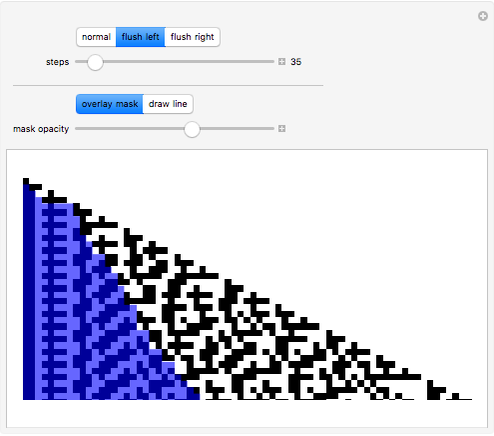
Snapshot 1: If all the rows are redrawn flush to the left border the structured region becomes more obvious. In fact, this shifted version of rule 30 can be emulated directly by rule 1,048,560 in the  ,
,  rule space. Rule 30 as an 8-bit binary number is 00011110, while rule 1,048,560 as a 32-bit binary number is 0000-0000-0000-1111-1111-1111-1111-0000. Each bit of rule 30 expands to 4 bits of rule 1,048,560.
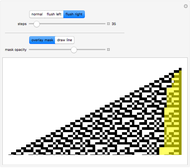
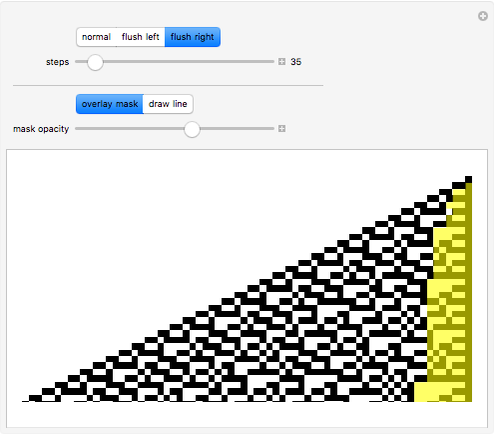
Snapshot 2: The regularity of the right-hand side is simpler. After the first 8 rows, the rows can be naturally grouped in powers of 2 starting with 8 rows, then 16, then 32, then 64, and so on.
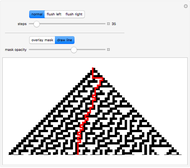
Snapshot 3: Alternate display.
Permanent Citation
"The Rule 30 Fault Line"
http://demonstrations.wolfram.com/TheRule30FaultLine/
Wolfram Demonstrations Project
Published: March 7 2011
 A CA-horus Line
John Kiehl Replicating Patterns in 2D Binary Cellular Automata with the Parity Rule
Hiroki Sayama Elementary Cellular Automaton Rules by Gray Code
Michael Schreiber Representing Elementary Cellular Automaton Rules
Daniel de Souza Carvalho De Bruijn Sequences Provide Compact Initial Conditions
John Kiehl A Bee's Eye View of Cellular Automata
John Kiehl Colorization of Cellular Automata
John Kiehl Classifying the Complexity and Information of Cellular Automata
Daniel de Souza Carvalho Radius-1/2 Cellular Automata
Daniel de Souza Carvalho Lattice Effects in Cellular Automata
Kovas Boguta and Fred Meinberg
-
 Musical Variables: Modes and Instruments
John Kiehl -
 Accidentals, on Purpose
John Kiehl -
 Stepping through k=3, r=1 Cellular Automata Rule Space
John Kiehl -
 Beating and Roughness
John Kiehl -
 A Visit to Sphereland
John Kiehl -
 A Visit to Flatland
John Kiehl -
 A Sphere Visits Flatland
John Kiehl -
 Musical Logo Widget
John Kiehl -
 Prospecting for Complexity in k=3, r=1 Cellular Automata
John Kiehl -
 Mamikon's Proof of the Pythagorean Theorem
John Kiehl -
 Hammer Time
John Kiehl -
 A Strategy for Exploring k=2, r=2 Cellular Automata
John Kiehl -
A CA-horus Line
John Kiehl -
 Hysteresis Modeled with Cellular Automata
John Kiehl -
 What Color Is the Bear?
John Kiehl -
 Refrigerator Poetry
John Kiehl -
 Two Lines Determine a Circle
John Kiehl -
 Root Routes
John Kiehl -
 Roots of Complex Numbers
John Kiehl -
 Complex Multiplication
John Kiehl