
Area, Perimeter, and Diagonal of a Rectangle with Uncertain Sides


Requires a Wolfram Notebook System
Interact on desktop, mobile and cloud with the free Wolfram Player or other Wolfram Language products.
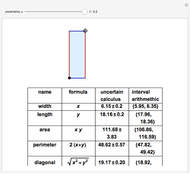
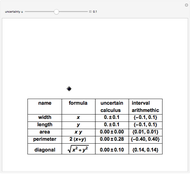
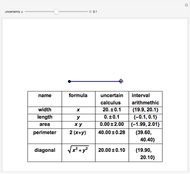
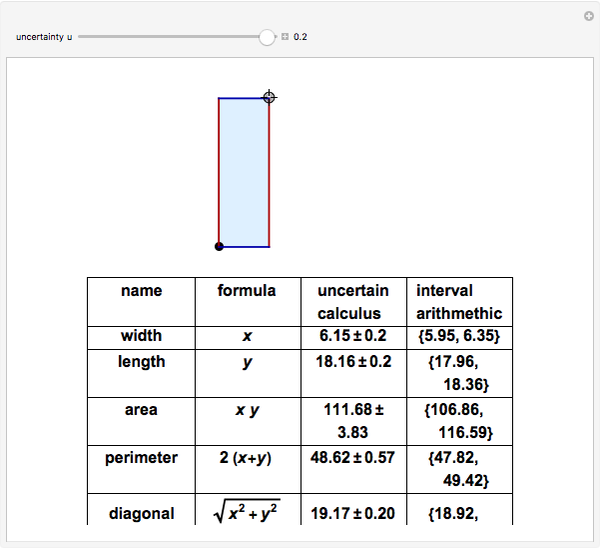
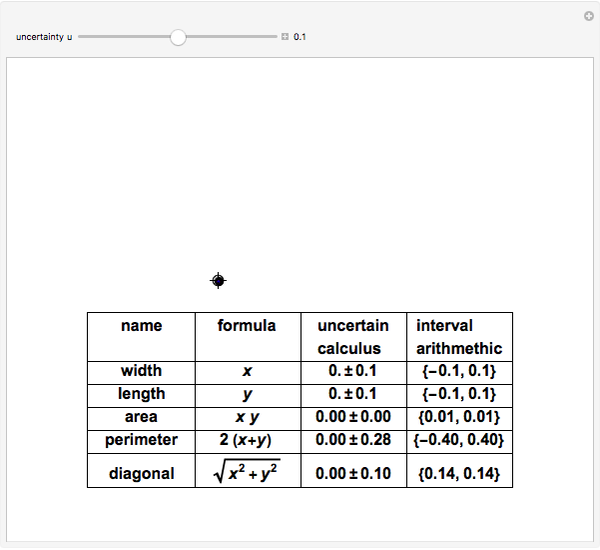
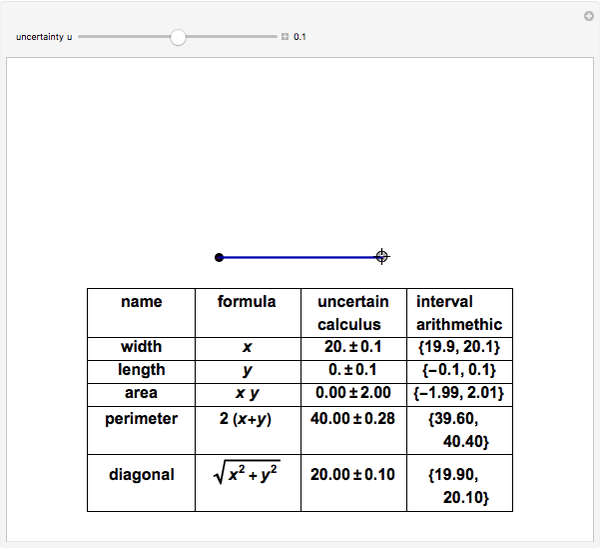
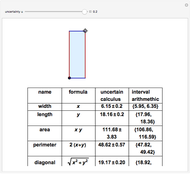
Using the uncertain calculus [1] and interval arithmetic, simple analytical solutions are derived and used to calculate the area, perimeter, and diagonal of a rectangle with the bottom left corner at the origin and the top right corner  defined by dragging the locator. The slider value
  is added as an uncertain part to .
Contributed by: Valter Yoshihiko Aibe and Mikhail Dimitrov Mikhailov (March 2011)
Open content licensed under CC BY-NC-SA
Snapshots
Details
There is international consensus on the evaluation of standard uncertainty and combined standard uncertainty in measurement and computations [1, 2]. Just as the International System of Units (SI) has brought coherence to all scientific and technological measurements, the worldwide consensus on uncertainty permits a vast spectrum of results to be readily understood and properly interpreted. The needs of numerous testing laboratories to calculate the measurement uncertainty on a large scale is supported by numerous software tools. Rasmussen [3] refers to 10 different software packages.
To facilitate the calculation of the combined standard uncertainty, Aibe and Mikhailov introduced a new object  called an uncertain number and developed in Mathematica an Uncertain Calculus package [4]. It is based on two assumptions: the functions manipulated have attribute NumericFunction and the relations Greater, GreaterEqual, Less, LessEqual, SameQ, Unequal, UnsameQ are independent of the uncertainties. The package transforms any functional relationship of uncertain numbers into an uncertain number, by using the general law of uncertainty propagation:
 .
.
The traditional uncertainty concept focuses on unknowable error and true value using the so-called general law of error propagation. The new concept is based on the estimated value and uncertainty using the same law of uncertainty propagation. Only the interpretation is different.
The rules extracted from the Uncertain Calculus package [5] and lists have been used to derive analytical solutions for uncertain and interval area, perimeter, and diagonal. A version of this Demonstration using uncertain calculus rules, interval arithmetic, and the derived analytical solutions has been explored to verify that both approaches give the same results. The present version only uses the analytical solutions.
References:
[1] European Cooperation for Accreditation of Laboratories, Expression of the Uncertainty of Measurement in Calibration, EAL-R2 and EAL-R2-S1, 1997.
[2] International Organization for Standardization, Guide to the Expression of Uncertainty in Measurement, Geneva, Switzerland: ISO, 1995.
[3] S. N. Rasmussen, "Software Tools for the Expression of Uncertainty in Measurement," MetroTrade Workshop on Traceability and Measurement Uncertainty in Testing, Berlin, January 30–31, 2003.
[4] V. Y. Aibe and M. D. Mikhailov, "Uncertainty Calculus in Metrology," Proceedings of ENCIT 2008, 12th Brazilian Congress of Thermal Engineering and Sciences, Belo Horizonte, MG, Brazil, November 10–14, 2008.
[5] "Solving Matrix Systems with Real, Interval, or Uncertain Elements" from The Wolfram Demonstrations Project
Permanent Citation
 Approximate Area and Circumference of a Circle Using Isosceles Triangles
Xiang Li Calculating Area, Perimeter, and Diagonal Length of a Rectangle
Bulbul Majumder Rectangles: Perimeter and Area
Sarah Lichtblau Estimating Perimeter and Area of Simple Polygons
Chris Boucher Bisecting the Area and Perimeter of a Triangle
Jaime Rangel-Mondragon Length of an Arc of an Ellipse and the Area It Subtends
Jaime Rangel-Mondragon Cylinder Area Paradox
George Beck and Izidor Hafner Area Approximation for Polar Plot
Michael Waters Monte Carlo Estimation of Area
Mark D. Normand and Micha Peleg Monte Carlo Methods to Estimate Area
Tomas Garza
-
 Flow around a Sphere at Finite Reynolds Number by Galerkin Method
Mikhail Dimitrov Mikhailov -
 Fit, Interpolation, or Polynomial Interpolation in Uncertain Calculus
Mikhail Dimitrov Mikhailov -
 An Expert System Specific to Improving Personal Relationships
Mikhail Dimitrov Mikhailov -
 Visualizing the Solution of Two Linear Differential Equations
Mikhail Dimitrov Mikhailov -
 Checking Finite Difference Errors
Mikhail Dimitrov Mikhailov -
 Concentrations of Multiple Reacting Species in a Semi-Infinite Region
Mikhail Dimitrov Mikhailov -
 Uncertain Calculus: Mean versus Likelihood Mean
Mikhail Dimitrov Mikhailov -
 Velocity Stream Lines from Superposition of Elementary Fluid Flows
Mikhail Dimitrov Mikhailov -
 Area, Perimeter, and Diagonal of a Rectangle with Uncertain Sides
Mikhail Dimitrov Mikhailov -
 Vector Field with Sources and Sinks
Mikhail Dimitrov Mikhailov -
 Laminar Flow between Two Eccentric Tubes
Mikhail Dimitrov Mikhailov -
 Numerical Evaluation of Some Definite Integrals
Mikhail Dimitrov Mikhailov -
 Convection-Diffusion in a Semi-Infinite Region
Mikhail Dimitrov Mikhailov -
 Solving Matrix Systems with Real, Interval, or Uncertain Elements
Mikhail Dimitrov Mikhailov -
 Solving a Linear System with Uncertain Coefficients
Mikhail Dimitrov Mikhailov -
 Expert System for Identifying Pedigree Dogs
Mikhail Dimitrov Mikhailov -
 Natural Convection between Two Vertical Plates
Mikhail Dimitrov Mikhailov -
 Penetration of Potential in a Semi-Infinite Region
Mikhail Dimitrov Mikhailov -
 Derivation of Thermodynamic Derivatives Using Jacobians
Mikhail Dimitrov Mikhailov -
 Finite Difference Schemes of One Variable
Mikhail Dimitrov Mikhailov