
Implied Volatility in Merton's Jump Diffusion Model



Requires a Wolfram Notebook System
Interact on desktop, mobile and cloud with the free Wolfram Player or other Wolfram Language products.
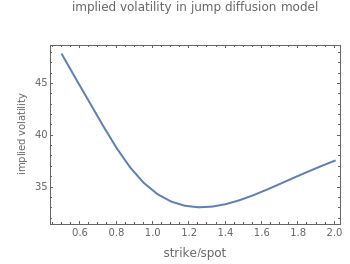
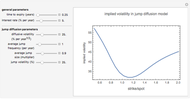
The "implied volatility" corresponding to an option price is the value of the volatility parameter for which the Black-Scholes model gives the same price. A well-known phenomenon in market option prices is the "volatility smile", in which the implied volatility increases for strike values away from the spot price. The jump diffusion model is a generalization of Black–Scholes in which the stock price has randomly occurring jumps in addition to the random walk behavior. One of the interesting properties of this model is that it displays the volatility smile effect. In this Demonstration, we explore the Black–Scholes implied volatility of option prices (equal for both put and call options) in the jump diffusion model. The implied volatility is modeled as a function of the ratio of option strike price to spot price.
Contributed by: Peter Falloon (March 2011)
Open content licensed under CC BY-NC-SA
Snapshots
Details
In the jump diffusion model, the stock price  follows the random process
  , which comprises, in order, drift, diffusive, and jump components. The jumps occur according to a Poisson distribution and their size follows a log-normal distribution. The model is characterized by the diffusive volatility
  , the average jump size
  (expressed as a fraction of ), the frequency of jumps
  , and the volatility of jump size
  .
.
In this Demonstration, you can vary the model parameters, along with the time to option expiry and the (constant) interest rate.
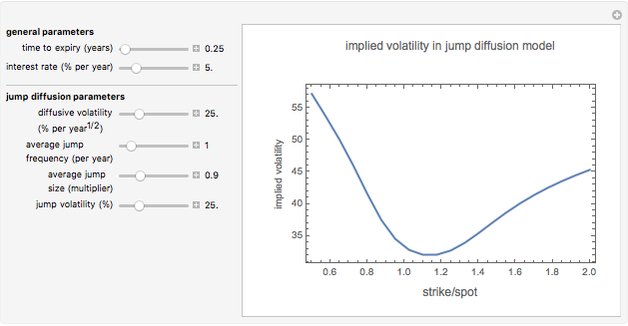
Note that, in addition to varying with the model parameters and strike/spot price ratio, the implied volatility is generally larger than the model diffusive volatility ; this is essentially the extra volatility introduced by the jumps.
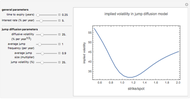
Snapshot 1: volatility smile in a jump diffusion model with downward jumps ( )
)
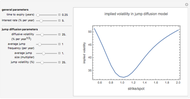
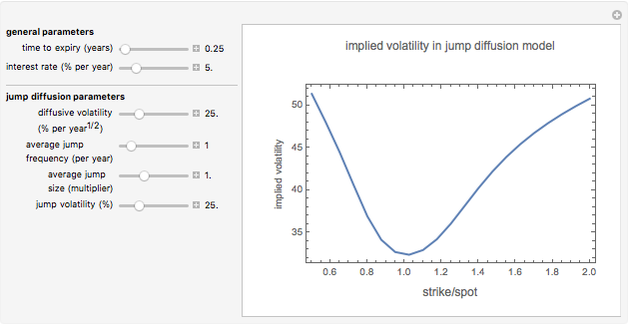
Snapshot 2: volatility smile with symmetric jumps ( )
)
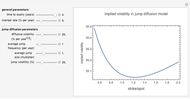
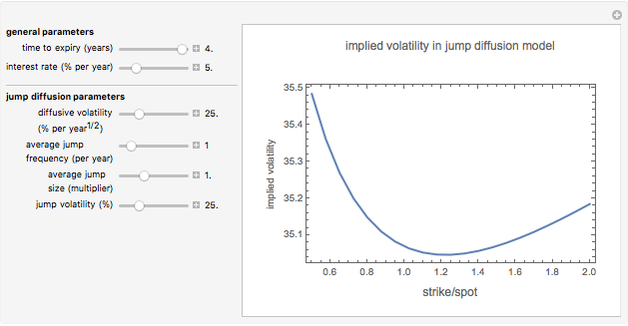
Snapshot 3: for long-dated options (here, time to expiry is four years) the smile is less pronounced
References:
R. Merton, Continuous‐Time Finance, Oxford: Blackwell, 1998.
M. Joshi, The Concepts and Practice of Mathematical Finance, Cambridge: Cambridge University Press, 2003.
Permanent Citation
 Option Prices in Merton's Jump Diffusion Model
Peter Falloon Distribution of Returns from Merton's Jump Diffusion Model
Peter Falloon Barrier Option Pricing within the Black-Scholes Model
Peter Falloon Pricing Power Options in the Black-Scholes Model
Peter Falloon Density of the Kou Jump Diffusion Process
Andrzej Kozlowski Markov Volatility Random Walks
Jason Cawley Options Board Using Black-Scholes Prices
Peter Falloon Bubbles in a Simple Behavioral Finance Model
Kevin W. Capehart Chooser Options
Peter Falloon Basic Option Trading Strategies
Peter Falloon
-
Option Prices in Merton's Jump Diffusion Model
Peter Falloon -
Chooser Options
Peter Falloon -
 Binary Options: Pricing and Greeks
Peter Falloon -
 Angular Spheroidal Functions as a Function of Spheroidicity
Peter Falloon -
 Hyperbolic Distribution
Peter Falloon -
 Variance-Gamma Distribution
Peter Falloon -
Options Board Using Black-Scholes Prices
Peter Falloon -
 Properties of a Simple Random Walk with Boundaries
Peter Falloon -
 Visualizing Superellipses
Peter Falloon -
 Haar Functions
Peter Falloon -
Barrier Option Pricing within the Black-Scholes Model
Peter Falloon -
 Clebsch-Gordan Coefficients
Peter Falloon -
 Constant Coordinate Curves for Elliptic Coordinates
Peter Falloon -
 Chi-Squared Distribution and the Central Limit Theorem
Peter Falloon -
 Multiple Slit Diffraction Pattern
Peter Falloon -
 Constant Coordinate Curves for Parabolic and Polar Coordinates
Peter Falloon -
Distribution of Returns from Merton's Jump Diffusion Model
Peter Falloon -
Pricing Power Options in the Black-Scholes Model
Peter Falloon -
 Implied Volatility in Merton's Jump Diffusion Model
Peter Falloon -
 Game Clock
Peter Falloon