
Lemon Batteries

Requires a Wolfram Notebook System
Interact on desktop, mobile and cloud with the free Wolfram Player or other Wolfram Language products.
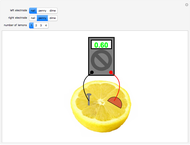
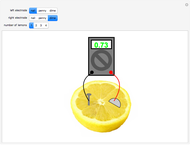
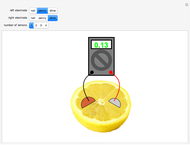
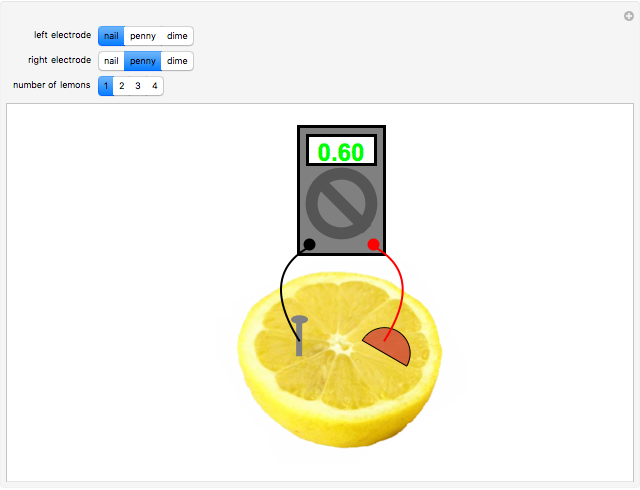
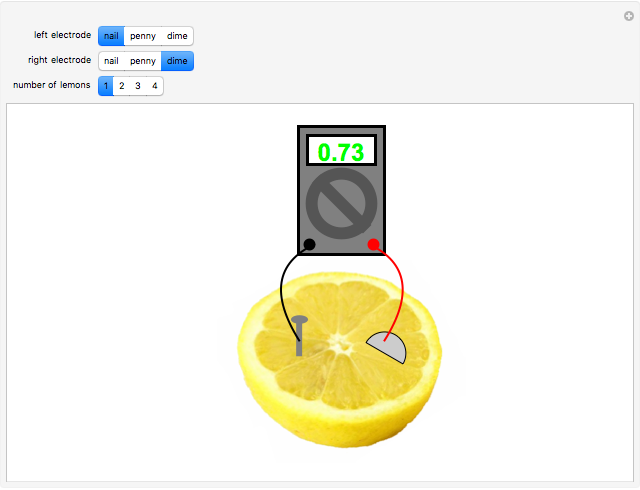
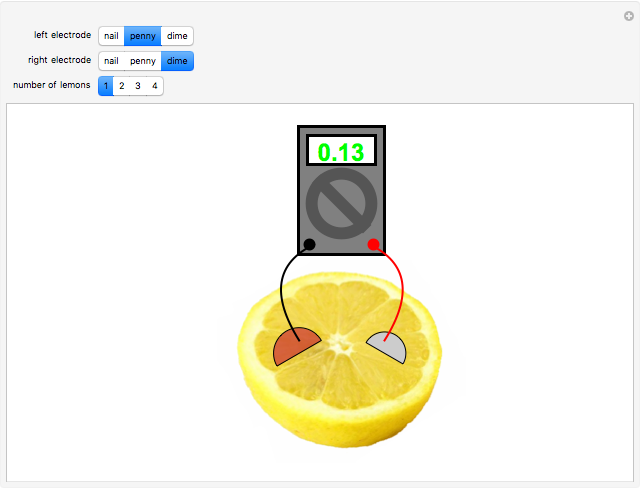
A rudimentary electrochemical cell can be constructed from two dissimilar metals immersed in an electrolyte. The lemon battery is a popular demonstrative example, with the highly acidic juicy insides providing an excellent electrolyte. The potential difference, usually of the order of a fraction of a volt, can be measured by a voltmeter connected to the two electrodes. The values shown in this Demonstration were determined by experiments in the author's laboratory. Combinations of three electrodes were tested: galvanized nails, pennies, and dimes, with compositions approximating those of zinc, copper, and silver, respectively. A positive voltage will be obtained if the left-hand electrode is the more electropositive metal. Reversing the electrodes (or voltmeter connections) gives the negative of the original reading. Two or more lemons can be connected in series to give multicell batteries.
Contributed by: S. M. Blinder (March 2011)
Open content licensed under CC BY-NC-SA
Snapshots
Details
Snapshots: the combinations Zn/Cu, Zn/Ag, Cu/Ag give readings of 0.60, 0.73 and 0.13 V, respectively; if the corresponding pure metals under standard conditions were used, the values should be 1.10, 1.56 and 0.46 V
Permanent Citation
"Lemon Batteries"
http://demonstrations.wolfram.com/LemonBatteries/
Wolfram Demonstrations Project
Published: March 7 2011
 Molecular Motion in Solids, Liquids, and Gases
S. M. Blinder Doped Silicon Semiconductors
S. M. Blinder Ideal Gas Law Solver
S. M. Blinder Build Your Own Atoms
S. M. Blinder Formulas and Structures for Some Simple Molecules
S. M. Blinder Making Some Simple Molecules
S. M. Blinder Structure of Water in Acid and Basic Media
S. M. Blinder Oxidation States of Carbon
S. M. Blinder Rotation about Carbon-Carbon Bonds
S. M. Blinder Filling the Gaps in Mendeleev's Periodic Table
S. M. Blinder
-
 Ice Cube Melting in Water
S. M. Blinder -
 Absorption Spectroscopy
S. M. Blinder -
 Height of Object from Angle of Elevation Using Tangent
S. M. Blinder -
 Internal Rotation in Ethane and Substituted Analogs
S. M. Blinder -
 Topological Spaces on Three Points
S. M. Blinder -
 Hydrogen Atom in Curved Space
S. M. Blinder -
 Multipurpose Tool
S. M. Blinder -
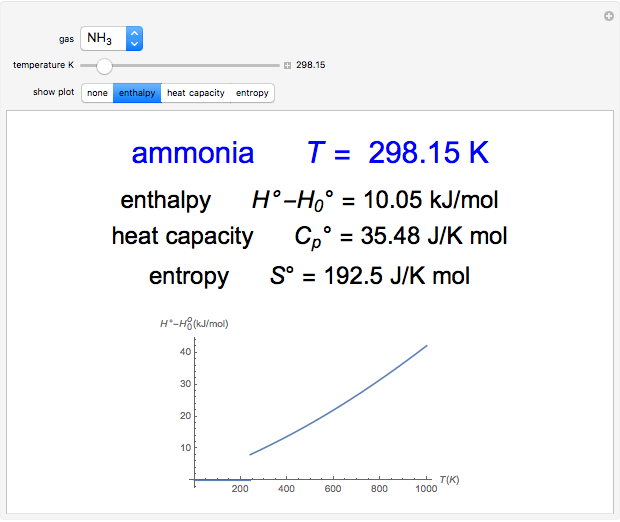 Statistical Thermodynamics of Ideal Gases
S. M. Blinder -
 Bell's Theorem
S. M. Blinder -
 Kepler's Mysterium Cosmographicum
S. M. Blinder -
 Bonding and Antibonding Molecular Orbitals
S. M. Blinder -
 Visible and Invisible Intersections in the Cartesian Plane
S. M. Blinder -
 Heron's Formula
S. M. Blinder -
 How Zippers Work
S. M. Blinder -
 Mittag-Leffler Expansions of Meromorphic Functions
S. M. Blinder -
 Orbital Resonance in the Asteroid Belt
S. M. Blinder -
 Jordan's Lemma Applied to the Evaluation of Some Infinite Integrals
S. M. Blinder -
 Configuration Interaction for the Helium Isoelectronic Series
S. M. Blinder -
 Structure and Bonding of Second-Row Hydrides
S. M. Blinder -
 DNA Base Pairing
S. M. Blinder