
Linear Dependence between Two Bernoulli Random Variables

Requires a Wolfram Notebook System
Interact on desktop, mobile and cloud with the free Wolfram Player or other Wolfram Language products.
The Pearson correlation coefficient, denoted  , is a measure of the linear dependence between two random variables, that is, the extent to which a random variable
  can be written as
  , for some
  and some
  . This Demonstration explores the following question: what correlation coefficients are possible for a random vector
  , where
  is a Bernoulli random variable with parameter
  and
and  is a Bernoulli random variable with parameter
  ? Interestingly, a two-dimensional Bernoulli random vector has a correlation coefficient that is constrained by the choices of and .
Contributed by: Jeff Hamrick (August 2008)
Open content licensed under CC BY-NC-SA
Snapshots
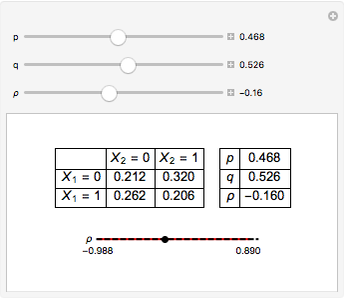
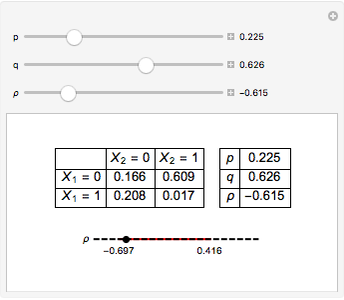
Details
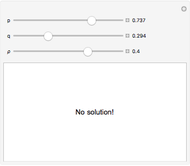
For the sake of simplicity, you are constrained to choose and that are slightly bounded away from 0 and 1.
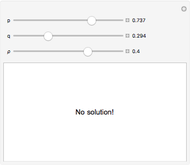
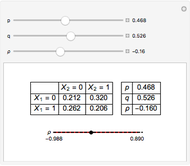
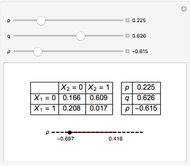
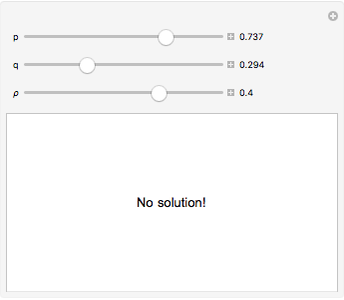
In the upper left-hand corner, there is a possible joint distribution of that accommodates your choices of , , and . Additionally, at the bottom is shown (with a red line) the linear correlation coefficients that are attainable for fixed choices of and . The basic lesson is clear: it is not possible to couple together two arbitrary Bernoulli random variables in such a way that any conceivable linear correlation coefficient is attained. Notice that choosing  maximizes the range of possible values of .
For a two-dimensional random vector  , where both
  and
and  are discrete random variables, finding a joint probability distribution that triggers a particular linear correlation coefficient is equivalent to solving a system of linear equations. It is not surprising, then, that sometimes this system of linear equations has no solution, a unique solution, or infinitely many solutions.
If in the  -dimensional random vector
  the
the  are Gaussian, then finding a joint probability distribution with a particular variance-covariance matrix (and, therefore, particular pairwise linear correlation coefficients between the coordinates of the -dimensional random vector) also happens to be equivalent to solving a system of linear equations. This fact is true for any elliptical distribution as well, that is, a distribution with a density function whose constant curves are ellipsoids. In general, however, the dependence between two or more random variables cannot be captured by a single number.
Permanent Citation
 The Method of Common Random Numbers: An Example
Jeff Hamrick Chebyshev's Inequality and the Weak Law of Large Numbers for iid Two-Vectors
Jeff Bryant and Chris Boucher Illustrating the Central Limit Theorem with Sums of Bernoulli Random Variables
Ian McLeod (University of Western Ontario) Joint Density of Trivariate Gaussian Random Variables
John M. Shea Joint Density of Bivariate Gaussian Random Variables
John M. Shea Records in Sequences of Random Variables
Heikki Ruskeepää Entropy of a Message Using Random Variables
Daniel de Souza Carvalho Distribution of the Sample Range of Continuous Random Variables
Heikki Ruskeepää Distribution of the Sample Range of Discrete Random Variables
Heikki Ruskeepää Normal Approximation to a Binomial Random Variable
Chris Boucher
-
 Expected Returns of the Dow Industrials, Beta Model
Jeff Hamrick -
 Exploring Measures of Association
Jeff Hamrick -
 Bootstrapping Credit Default Swap Data
Jeff Hamrick -
 Linear Dependence between Two Bernoulli Random Variables
Jeff Hamrick -
 Estimating the Local Mean Function
Jeff Hamrick -
 Acceptance/Rejection Sampling
Jeff Hamrick -
 Simulating the 2008 U.S. Presidential Election
Jeff Hamrick -
 The Method of Inverse Transforms
Jeff Hamrick -
 The Perturbed Rat
Jeff Hamrick -
 Modeling Return Distributions
Jeff Hamrick -
 Pricing a European-Style Arithmetic Asian Option: Comparing Bootstrapping and Simulation Approaches
Jeff Hamrick -
The Method of Common Random Numbers: An Example
Jeff Hamrick -
 The Envelope Theorem: Numerical Examples
Jeff Hamrick -
 Bootstrapping to Compute Value-at-Risk Standard Errors
Jeff Hamrick -
 Expected Returns of the Dow Industrials, Fama-French Model
Jeff Hamrick -
 Kernel Density Estimation
Jeff Hamrick -
 Simulating Asset Prices with a GARCH(1,1) Model
Jeff Hamrick