
Local Behavior of a Polynomial near a Root
Initializing live version


Requires a Wolfram Notebook System
Interact on desktop, mobile and cloud with the free Wolfram Player or other Wolfram Language products.
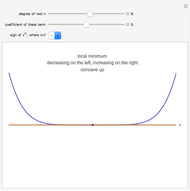
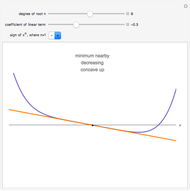
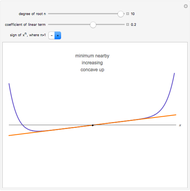
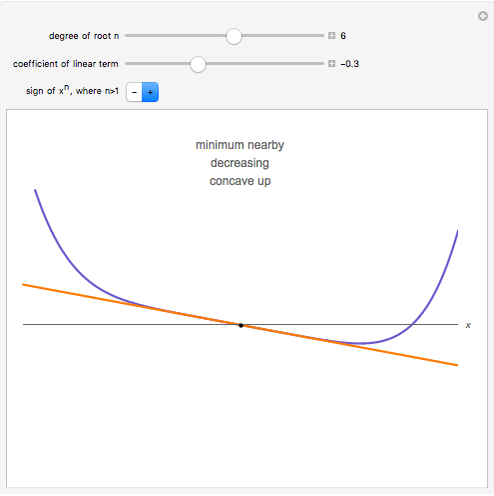
All properties described only hold locally near the root. For example, a locally increasing function may decrease a short distance away.
[more]


Contributed by: George Beck (March 2011)
Open content licensed under CC BY-NC-SA
Snapshots


Details
Permanent Citation
Related Demonstrations
More by Author
 Simple Spline Curves
Richard Phillips and Rob Morris Polynomial Roots in the Complex Plane
Faisal Mohamed A Fifth-Degree Polynomial and Its Derivatives
Charles Wells Zeros of a Polynomial or Rational Function and Its Derivative
D. Meliga and S. Z. Lavagnino Rational Roots of a Polynomial
Izidor Hafner How the Roots of a Polynomial Depend on Its Constant Coefficient
Izidor Hafner The Eneström-Kakeya Bounds for Roots of a Polynomial with Positive Coefficients
Andrzej Kozlowski Integer Polynomial
Eric W. Weisstein Polynomial Fitter
Rob Morris Annotated Quadratic Polynomial
Stephen Wolfram
-
 Vertex and Edge Truncations of the Platonic Solids
George Beck -
 Multiplying a Matrix by a Number
George Beck -
 Matrix Addition and Subtraction
George Beck -
 Plot a Quadratic Inequality
George Beck -
 Insphere and Four Exspheres of a Tetrahedron
George Beck -
 Permutations, k-Permutations and Combinations
George Beck -
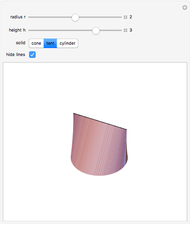 Cone, Tent, and Cylinder
George Beck -
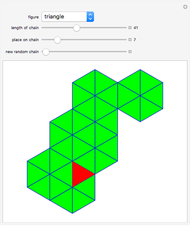 Chains of Regular Polygons and Polyhedra
George Beck -
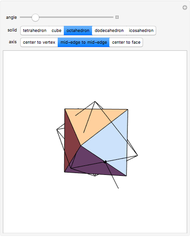 Rotational Symmetries of Platonic Solids
George Beck -
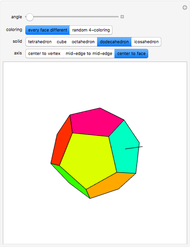 Rotational Symmetries of Colored Platonic Solids
George Beck -
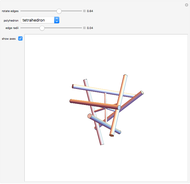 Duals by Rotating the Edges of Polyhedra
George Beck -
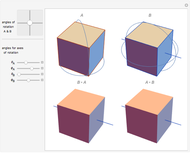 Combining Two 3D Rotations
George Beck -
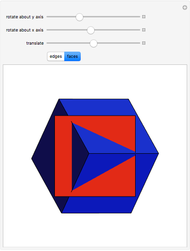 Passing a Cube through a Cube of the Same Size
George Beck -
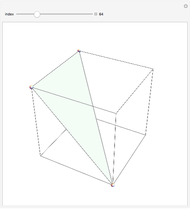 0/1-Polytopes in 3D
George Beck -
 The Path of a Ray on a Cube
George Beck -
 Applications of Lanchester's Square Law
George Beck -
 Eulerian Numbers versus Stirling Numbers of the First Kind
George Beck -
 Multiple Reflections of a Regular Polygon in Its Sides
George Beck -
 The Four-Runner Problem
George Beck -
 Iteratively Reflecting a Point in the Sides of a Triangle
George Beck