
Nash Equilibria with Continuous Strategies

Requires a Wolfram Notebook System
Interact on desktop, mobile and cloud with the free Wolfram Player or other Wolfram Language products.
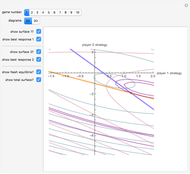
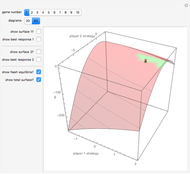
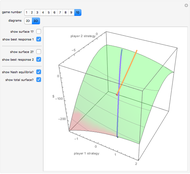
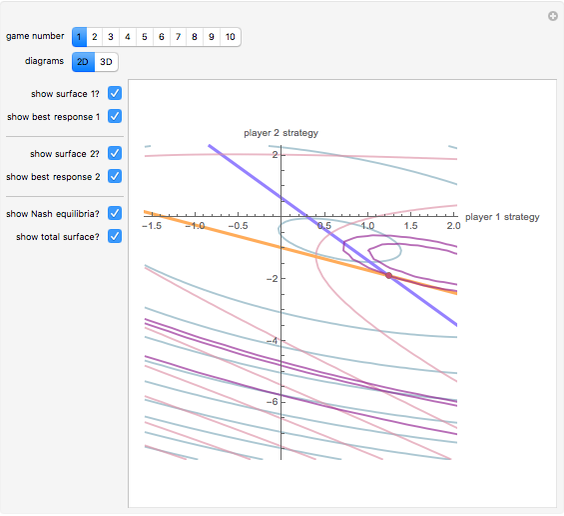
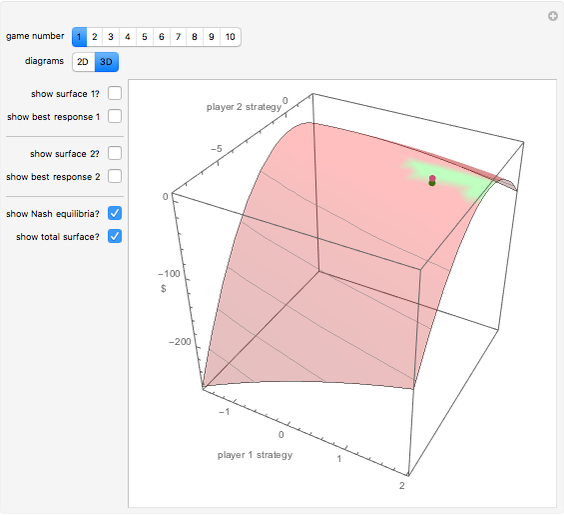
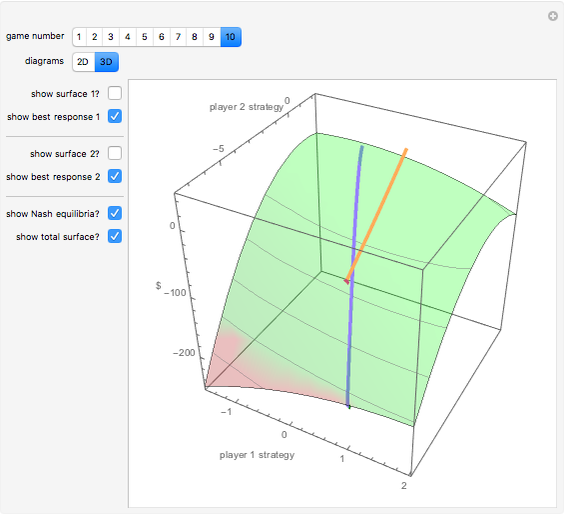
A Nash equilibrium of a game is a strategy combination such that no party can improve its situation by changing its strategy, assuming the complementary strategies of the other players stay the same. The strategies are said to be "mutual best responses." This Demonstration lets you examine 10 continuous strategy games and see the payoff surfaces of each of the players as well as the sum of the payoffs. These surfaces can be visualized in three dimensions or in two dimensions. The Demonstration also calculates "best response" curves for each of the players, shown in orange and blue, respectively, and projects the Nash equilibrium point onto each best response curve. The total payoff surface is colored green for those strategy combinations that would improve total wealth relative to that achieved at the Nash equilibrium. The "green zone" thus represents the strategy combinations that, if wealth were transferrable between the players through enforceable contracts, would be Pareto superior to the Nash equilibrium.
Contributed by: Seth J. Chandler (March 2011)
Open content licensed under CC BY-NC-SA
Snapshots
Details
In the two-dimensional graphic, player 1's contours are colored aqua, player 2's contours are colored pink, and the total contours are colored violet.
Snapshot 1: a contour plot of the payoff surfaces and total surface
Snapshot 2: the graphic in which only the total payoffs are showing
Snapshot 3: a scenario in which the loss resulting from playing non-cooperatively can be quite large; the graphic has been rotated and the player payoff surfaces deleted for clarity
Permanent Citation
"Nash Equilibria with Continuous Strategies"
http://demonstrations.wolfram.com/NashEquilibriaWithContinuousStrategies/
Wolfram Demonstrations Project
Published: March 7 2011
 Nash Equilibria in 3×3 Games
Seth J. Chandler Payoff Gradients in Two-Player Games
Seth J. Chandler Iterated Games
Seth Chandler Binary Election Sequences
Seth J. Chandler The Purpose of the Law
Seth J. Chandler Bilateral Accident Model
Seth J. Chandler Property Coinsurance
Seth J. Chandler Occurrence versus Claims-Made Insurance Policies
Seth J. Chandler A Minimal Circumcircle Measure of District Compactness
Seth J. Chandler Estimating Insurance Premiums Using Exceedance Data and the Method of Moments
Seth J. Chandler
-
 Post-Event Bonding
Seth J. Chandler -
 Emulating Land Use Evolution with a Cellular Automaton
Seth J. Chandler -
 General Assembly Resolution Viewer
Seth J. Chandler -
 Random Acyclic Networks
Seth J. Chandler -
 A Theory of Insurance Lapses
Seth J. Chandler -
 Asylum in the United States
Seth J. Chandler -
Property Coinsurance
Seth J. Chandler -
 The Persuasion Effect: A Traditional Two-Stage Jury Model
Seth J. Chandler -
 Cellular Automata with Global Control
Seth J. Chandler -
 Sports Seasons Based on Score Distributions
Seth J. Chandler -
 Evidentiary Uncertainty
Seth J. Chandler -
 Spectral Measures
Seth J. Chandler -
 The Banzhaf Power Index of States for Presidential Candidates
Seth J. Chandler -
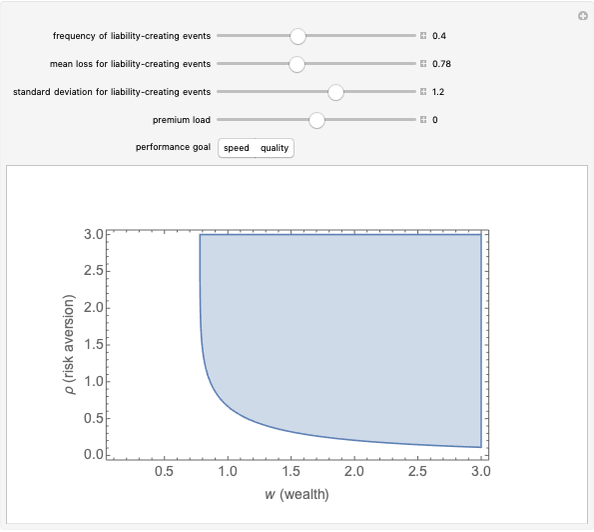 Liability Insurance Desirability under Lognormal Loss Distributions
Seth J. Chandler -
 The Effects of Coinsurance and Deductibles on Optimal Precautions for Weibull-Distributed Loss
Seth J. Chandler -
 Collocation by Chi Square
Seth J. Chandler -
 The Present Value of Future Gas Use
Seth J. Chandler -
 Visualizing Legal Rules: A Homicide Case
Seth J. Chandler -
 Communities of Nations Bridged by Language Similarity
Seth J. Chandler