
Time-Dependent Scattering in the Causal Interpretation of Quantum Theory



Requires a Wolfram Notebook System
Interact on desktop, mobile and cloud with the free Wolfram Player or other Wolfram Language products.
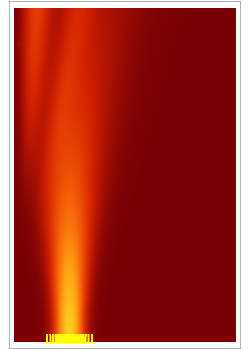
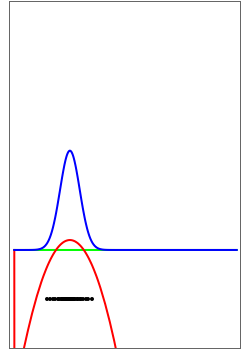
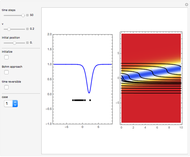
This Demonstration shows an analytic time‐dependent Gaussian wave packet with initial width  and group velocity u in the (
 ,
,  ) space, which is reflected by a potential with an infinite wall at
  . The wavefunction is given by:
  , where
  and
and  are solutions of the free Schrödinger equation
  with
with  . The superposition of the two wavefunctions satisfies the boundary condition
  , which can be interpreted as the behavior of a quantum particle in a potential
  with
with  for
for  and
and  for
for  . This method is similar to image methods in electrostatics. The motion of the particles is obtained by integrating the gradient of the phase function from the eikonal form of the wavefunction. To show how the evolution of the particle depends on its initial position, the starting points are arranged in a Gaussian distribution around the peak
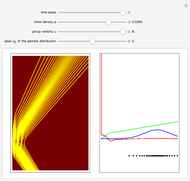
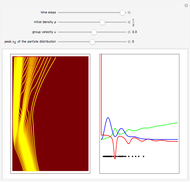
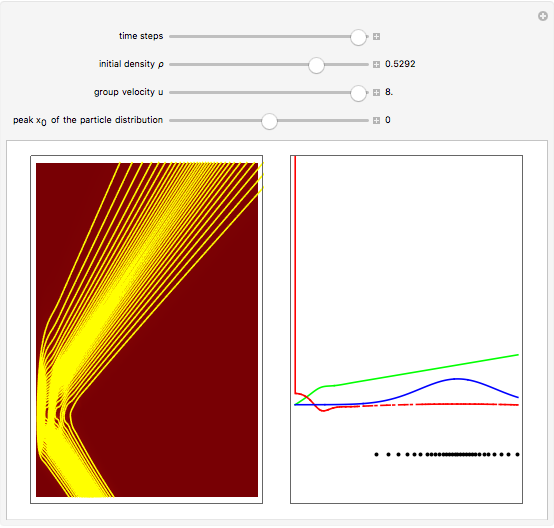
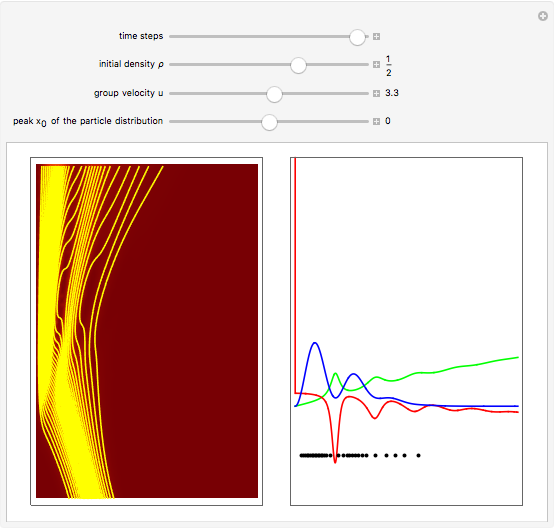
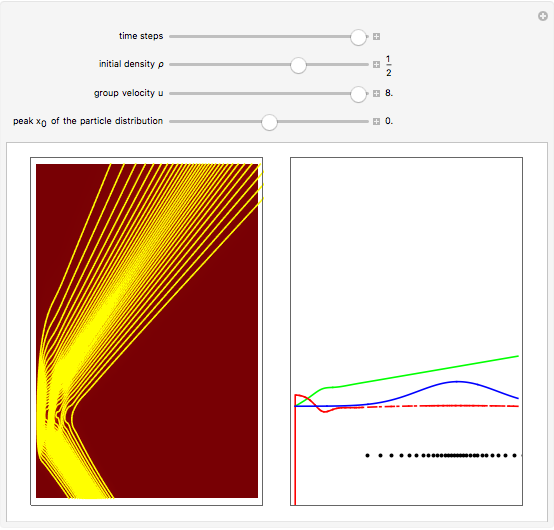
  inside the wave, not related to the actual Gaussian distribution of the wavefunction. Trajectories never cross and no particles ever reach the wall. They are brought to rest, turned around, and follow the maximum of the squared wavefunction (pattern of fringes). The particles never tunnel through the wall, with those on the rear side of the packet "bouncing" back far from the wall. This is a nonclassical feature of the Bohm model. In the causal interpretation, the motion of the particles is guided by the sum of the potential
  and the quantum potential; the trajectories can never be measured directly.
Contributed by: Klaus von Bloh (March 2011)
Open content licensed under CC BY-NC-SA
Snapshots
Details
References:
M. Belloni, M. A. Doncheski, and R. W. Robinett, "Exact Results for 'Bouncing' Gaussian Wave Packets," Phys. Scripta 71, 2005 pp. 136–140 arXiv:quant-ph/0408182v1.
C. Dewdney, B. J. Hiley, "A Quantum Potential Description of One-Dimensional Time-Dependent Scattering from Square Barriers and Square Wells," Found. Phys. 12(1), 1982 pp. 27–48.
 Causal Interpretation of the Double-Slit Experiment in Quantum Theory
Klaus von Bloh Radioactive Decay in the Causal Interpretation of Quantum Theory
Klaus von Bloh Simple Chaotic Motion of Quantum Particles According to the Causal Interpretation of Quantum Theory
Klaus von Bloh Causal Interpretation of the Quantum Harmonic Oscillator
Klaus von Bloh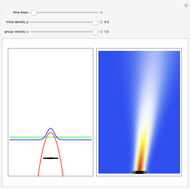 Causal Interpretation of the Free Quantum Particle
Klaus von Bloh The Causal Interpretation of Quantum Tunneling through a Square Barrier and Well
Klaus von Bloh Influence of the Relative Phase in the de Broglie-Bohm Theory
Klaus von Bloh Double Delta Function Scattering Potential
Peter Falloon Compton Scattering of Subatomic Particles
Nuwan Karunaratne Quantum Well Explorer
Richard Gass
-
 Bohm Trajectories for the Two-Dimensional Coulomb Potential
Klaus von Bloh -
 Bohm Trajectories in an LCAO Approximation for the Hydrogen Molecule H_2
Klaus von Bloh -
 Decoherence and Trajectories Implied by a Modified Schrodinger Equation
Klaus von Bloh -
 Bohm Trajectories for a Particle in a Two-Dimensional Circular Billiard
Klaus von Bloh -
 From Bohm to Classical Trajectories in a Hydrogen Atom
Klaus von Bloh -
 Continuous Transition between Quantum and Classical Behavior for a Harmonic Oscillator
Klaus von Bloh -
 Continuous Transition between Classical and Bohm Quantum Pictures for Young's Interference Experiment
Klaus von Bloh -
 Bohm Trajectories for Quantum Particles in a Uniform Gravitational Field
Klaus von Bloh -
 Bohm Trajectories for a Particle in a Two-Dimensional Calogero-Moser Potential
Klaus von Bloh -
 Nonlocality in the de Broglie-Bohm Interpretation of Quantum Mechanics
Klaus von Bloh -
 Three-Soliton Collision in the Trajectory Approach
Klaus von Bloh -
 The Which-Way Experiment and the Conditional Wavefunction
Klaus von Bloh -
 Chaotic Quantum Motion of Two Particles in a 3D Harmonic Oscillator Potential
Klaus von Bloh -
 Perturbation Theory in the de Broglie-Bohm Interpretation of Quantum Mechanics
Klaus von Bloh -
 Periodic Quantum Motion of Two Particles in a 3D Harmonic Oscillator Potential
Klaus von Bloh -
 Quantum Motion of Two Particles in a 3D Trigonometric Pöschl-Teller Potential
Klaus von Bloh -
 The Talbot Carpet in the Causal Interpretation of Quantum Mechanics
Klaus von Bloh -
 Bohmian Quantum Trajectories for Coherent States of the Pöschl-Teller Potential
Klaus von Bloh -
 Gray and Dark Solitons in the de Broglie and Bohm Approaches
Klaus von Bloh -
 A Breather Solution in the Causal Interpretation of Quantum Mechanics
Klaus von Bloh